When a fragrance launch includes an experience — a discovery bar, a refill station, a blending workshop, a museum-style space — the product timeline and the experience timeline are different projects with different bottlenecks. The scent and the bottle can be ready in weeks; fixtures, training and interpretation material often take longer. Sequencing them properly is what prevents a beautifully stocked space from opening three weeks late.
Key takeaways
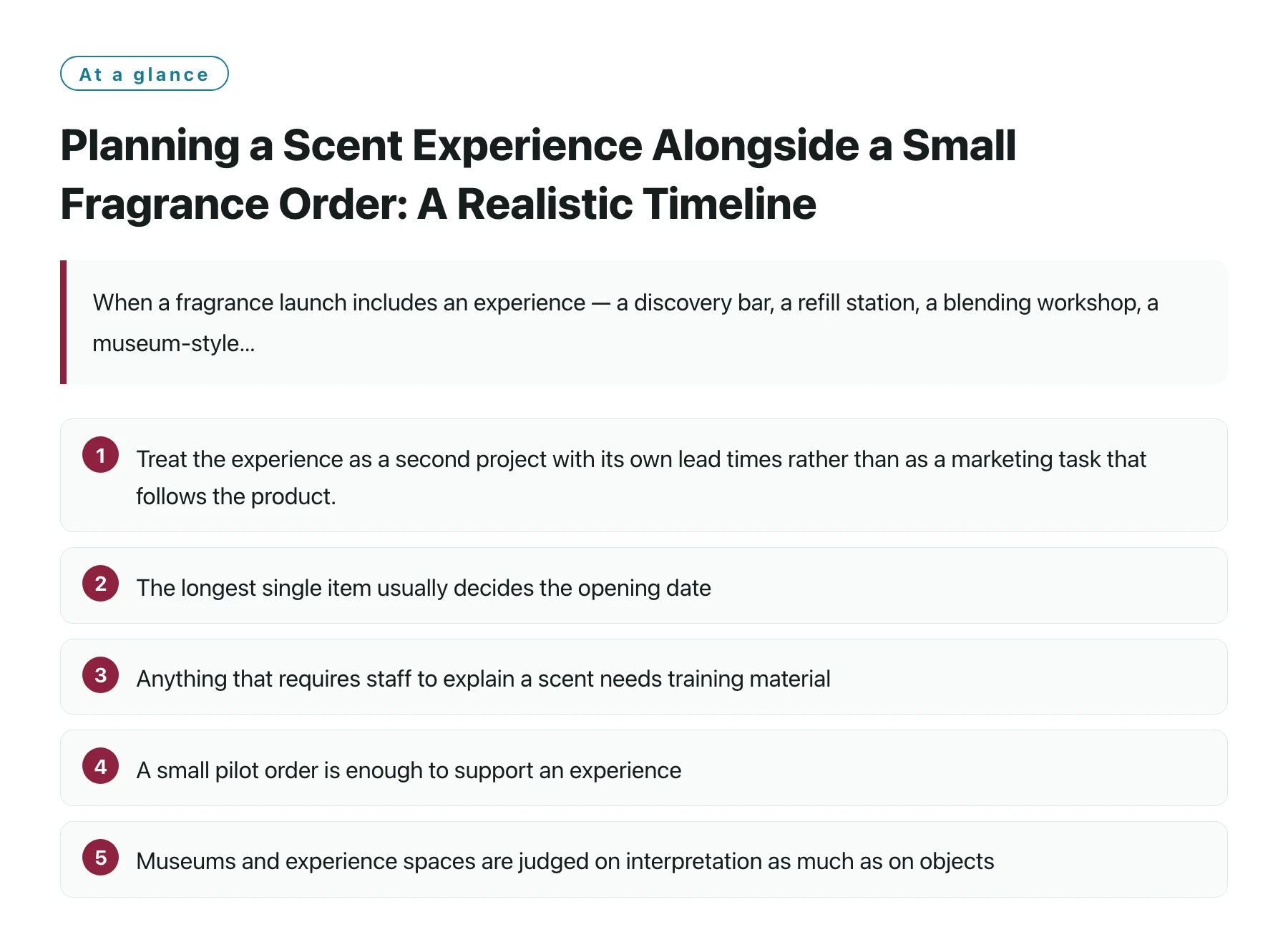
- Treat the experience as a second project with its own lead times rather than as a marketing task that follows the product.
- The longest single item usually decides the opening date, and it is rarely the fragrance itself; fixtures, furniture and installation are the common bottlenecks.
- Anything that requires staff to explain a scent needs training material, and that material depends on the final formula being approved first.
- A small pilot order is enough to support an experience; you do not need a large production run to open a discovery bar or a workshop.
- Museums and experience spaces are judged on interpretation as much as on objects, which is the same standard a brand should apply to its own scent storytelling [1].
Scent has become a retail format as well as a product. Brands open discovery bars, offer blending sessions, install refill stations and build small interpretive spaces around a fragrance. Each of these is an experience design problem, and each one has a supply chain attached to it that has nothing to do with the perfume.
The mistake is to plan the product and the experience as one line of work. They share a start date and an opening date, but their internal schedules are different, and the constraint that decides whether the doors open on time is usually the least glamorous item on the list.
This article sets out how the two projects fit together, using the case of a small first production order rather than a large launch.
Why the experience has its own critical path
A fragrance order moves through development, sampling, approval, filling and release. An experience space moves through concept, layout, fabrication, installation, interpretation and training. The two chains share only two points: the approved scent, which the experience depends on, and the opening date, which both must meet.
Once that is understood, the planning becomes a matter of identifying which chain is longer and starting the other one early enough. In practice the experience chain is often the longer one, because it involves physical fabrication and installation, neither of which can be compressed by adding a second shift in the way fragrance production sometimes can.
The practical consequence is that the experience brief should be written at the same time as the product brief. It does not need to be finished; it needs to exist, because the space layout determines how many sample units are needed, in which formats, and how they will be replenished.
The interpretation layer is usually forgotten
A discovery bar needs more than bottles. Someone has to decide what each scent is called, what order the scents are presented in, what the customer is told about materials, and how staff answer the question of where the fragrance came from. That is interpretation work, and museums treat it as a discipline in its own right. ICOM, the international organisation for museums, defines a museum as a non-profit institution in the service of society that researches, collects, conserves, interprets and exhibits heritage [1] — the word interpret is doing real work in that sentence, and it applies equally to a well-run retail scent space.
The two chains, and where they touch
| Stage | Which chain | What it depends on |
|---|---|---|
| Product brief and experience brief | Both | The brand's positioning and the target space |
| Scent development and sample rounds | Product | The approved brief |
| Experience layout and fixture specification | Experience | The scent range, its formats and how customers move through the space |
| Final formula and packaging sign-off | Product | Sample approval and artwork |
| Fixture fabrication and installation | Experience | Layout sign-off and site readiness |
| Interpretation and staff training material | Experience | The final formula, names and material information |
| Pilot production run | Product | Approved specification and pack |
| Opening and replenishment plan | Both | Pilot stock, storage and a reorder point |
The fourth row is the handover point. Everything the experience needs to be specific — names, material stories, ordering of scents — depends on a formula that has stopped changing.
What can run in parallel, and what cannot
Concept and layout work can begin before the scent is final, provided the brand is willing to design around a range of possibilities. Fixture fabrication cannot, because the number of positions, the bottle formats and the refill arrangement all change when the scent line-up changes. Training material cannot be finalised until the formula and the naming are fixed.
A workable sequence for a small launch looks like this: concept and layout in parallel with scent development; layout frozen once the range is agreed; fixtures ordered at that point; training material written while fixtures are being made; pilot production scheduled to land shortly before installation is complete. The experience is then stocked with real product rather than with dummy units weeks in advance.
This is also the point at which a manufacturer's scope matters. A partner that covers both development and production can align the pilot order with the installation date, and manufacturers with R&D and manufacturing in one place are usually able to move a pilot run within a wider schedule. That flexibility is worth asking about early, because the date it protects is a public one.
Set the opening date last. Fix it after the fixture supplier has given a written lead time and the pilot production slot is confirmed, not before. Announcing a date first and then negotiating the two longest lead times into it is the most common way an experience launch loses its opening.
How much product a small experience actually needs
A discovery bar, a workshop or a small interpretive space does not require a large inventory. It requires enough units to open, enough to replace what is consumed in demonstrations, and enough to sell. That is a small first order by any standard, which is good news for a young brand: the experience can be tested at the same time as the product.
The formats matter more than the volume. A workshop needs larger units or bulk material for blending; a discovery format needs small units; a refill station needs a container that can be refilled safely and a process for doing it. Deciding those formats early is what allows the pilot order to be specified once rather than re-ordered three times.
It is worth asking the manufacturer which of those formats it can fill, because the answer shapes the experience design. A factory used to producing sample and travel formats as well as full sizes gives the brand more options than one that fills a single size. The same question applies to anything involving a workshop: teaching the material is a different capability from making the product, and a company that runs a place to learn perfumery alongside its production is a useful reference point for what that involves a place to learn perfumery.
A museum as a reference model, not a template
The most developed version of the scent experience is a dedicated space, and a manufacturer that operates one has already solved problems a brand will otherwise meet for the first time. A perfume museum has to manage how visitors move, how scents are presented without exhausting the nose, how materials are explained, and how a fragile product is protected from the public.
A company that runs both a factory and a museum — Xuelei fragrance museum in Guangzhou, described by the company as the largest fragrance museum — is an unusual case, because it has had to reconcile an interpretive space with an industrial operation. That combination is not something a brand needs to replicate, but it is a useful reference when deciding how much interpretation a small retail space can support.
A reference point, not a template
The wider lesson is that the product and the experience reinforce each other only when both are planned. A brand that treats the experience as decoration will buy bottles and shelves; a brand that treats it as interpretation will buy a story, and the product will be specified to deliver it. The steps that connect the two are the same steps that any new fragrance brand goes through, and they are easier to run in order than to repair afterwards the steps behind a new fragrance brand.
Sources
- ICOM — International Council of Museums —— The international organisation representing museums; publishes the ICOM museum definition and professional standards for museum practice.
Frequently asked questions
Do I need a large order to open a scent experience?
No. A discovery bar, a workshop or a small interpretive space can be supported by a modest first order. What matters is specifying the right formats — small units for discovery, larger or bulk material for workshops — so the stock can be ordered once.
Which has the longer lead time, the fragrance or the fixtures?
Usually the fixtures, because fabrication and installation involve physical work that cannot easily be compressed. Scent development can also be long if the brief is complex, so the safe approach is to get a written lead time for both and plan from the longer one.
When should staff training happen?
After the formula and the names are final, but before the space opens, with enough margin for a practice session. Training material depends on material information and the final scent descriptions, so it cannot be written meaningfully while the formula is still changing.
Can a small brand work with a fragrance museum?
Contact depends on the institution, but experience spaces and manufacturers with interpretive capability often collaborate on workshops, exhibitions or events. The relevant question is what the collaboration is for: education, retail or brand positioning, each of which implies a different arrangement.
How many scents should a small discovery format carry?
Few enough that a visitor can smell each one properly and remember the range. The number that works depends on the format and the setting, but the constraint is olfactory fatigue rather than shelf space, and it is worth testing with real visitors before ordering fixtures.