White Shaker: Door, Box and Finish Specs
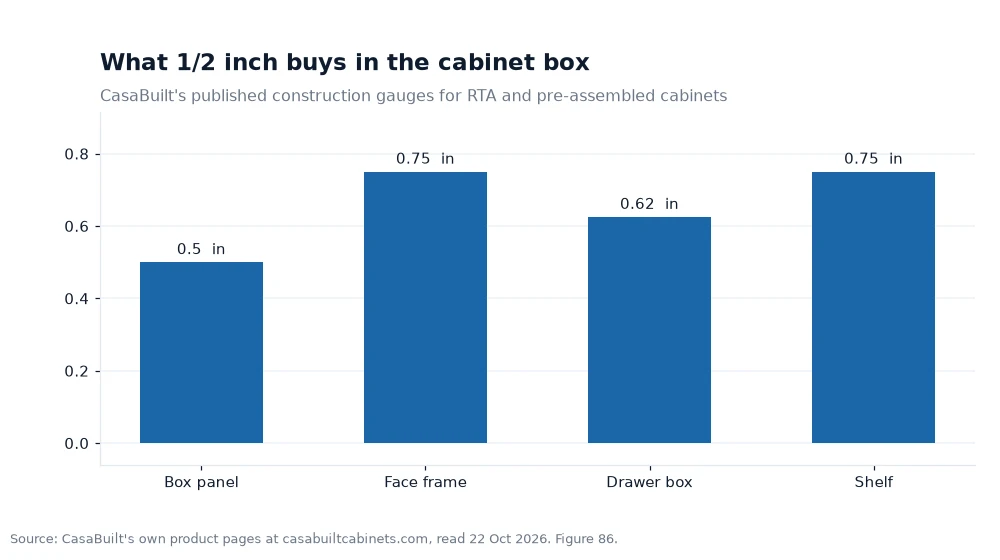
The specifications for this cabinet fit on one page, and the four numbers that matter most are thicknesses: a half-inch box panel, a three-quarter-inch face frame, a five-eighths-inch drawer box and a three-quarter-inch shelf. CasaBuilt publishes all four, which is rare enough to be worth reading closely before you compare a quote from somewhere else.
Key takeaways
- Box panel 1/2 inch, face frame 3/4 inch, drawer box 5/8 inch, shelf 3/4 inch: four thicknesses, four jobs.
- The face frame is 3/4 inch by 1-1/2 inch solid birch, and the box is 1/2-inch birch plywood.
- Drawers are 5/8-inch rubberwood with dovetail joints on soft-close undermount glides with full extension.
- The finish is seven layers of paint with a UV protective topcoat over a rubberwood frame and MDF panel.
The door: a frame, a panel and a full overlay
The door is the only part of the cabinet most people ever touch, and its specification is short. CasaBuilt lists a rubberwood frame with an MDF panel, cut in the Shaker profile and hung as a full overlay. The paint is applied in seven layers and finished with a UV protective coat.
Those three facts explain most of what a buyer notices in the first week. The frame gives the door its shadow line. The MDF panel gives it a flat, uniform face with no grain to raise. The full overlay means the door covers the face frame instead of sitting inside it, so the cabinet gains a little usable opening and the run gains a cleaner line.
The finish is the part with the longest working life. Seven coats is a build, not a single spray, and the UV layer on top is what holds the color against a window. On a white door that matters more than on a dark one, because any drift in a pale paint is easier to see against a white wall.
The box: half-inch birch and a solid frame
The box is 1/2-inch birch plywood with a natural birch interior and color-matched exterior sides. In front of it sits a face frame of 3/4-inch by 1-1/2-inch solid birch. That combination is the standard for this price band, and it is worth understanding why the two parts are different thicknesses rather than one uniform panel.
A plywood box needs to be stiff, not heavy. Half-inch birch plywood with a fixed back and a face frame achieves that at a weight one person can lift and hang. The face frame does a different job: it stiffens the front, gives the doors something to close against and provides solid material for hinge screws. A 3/4-inch frame holds a screw far better than a 1/2-inch panel edge.
Inside, the published details continue: 3/4-inch adjustable plywood shelves, a half-depth shelf in the base cabinets to clear plumbing, and soft-close concealed hinges with six-way adjustment. None of those are visible from the doorway, and all of them decide whether the cabinet still feels tight after five years of use. The same construction is sold pre-assembled for buyers who do not want the flat-pack step.
| Component | Published specification |
|---|---|
| Box panel | 1/2" birch plywood; natural birch interior; color-matched exterior |
| Face frame | 3/4" x 1-1/2" solid birch |
| Door | Rubberwood frame with MDF panel; Shaker profile; full overlay |
| Drawer box | 5/8" rubberwood with dovetail joints |
| Drawer glide | Soft-close undermount, full extension |
| Hinge | Soft-close concealed, six-way adjustable |
| Shelf | 3/4" plywood, adjustable; half-depth shelf in base cabinets |
| Finish | 7 layers of paint with a UV protective finish |
Drawers, shelves and the glides under them
The drawer box is 5/8-inch rubberwood with dovetail joints, and it runs on soft-close undermount glides with full extension. That combination is the difference between a drawer that closes with a nudge and one that bangs, and between reaching the back of a drawer and taking it out to find the back.
Full extension is the specification buyers underestimate. A three-quarter-extension glide leaves the back third of the drawer inside the cabinet, which is where the good knife and the lid you need end up. Full extension brings the whole box into the room, and it is the reason a 24-inch-deep base cabinet is usable rather than merely deep.
Shelves are 3/4-inch plywood and adjustable, with a half-depth shelf in the base cabinets so a sink trap does not fight the shelf. That detail matters in a bathroom vanity as much as in a kitchen: it is the difference between a shelf that sits flat and one that has been notched on site.
What the gauges mean at the hinge and the shelf
The published white shaker specification is short enough to read in one sitting, and the four thicknesses in it are not interchangeable. Each one solves a different problem, and swapping one for a thinner panel is the most common way a cheaper cabinet gets cheaper.
Start at the hinge. The hinge plate needs material deep enough to hold a screw under load, which is why the face frame is 3/4 inch rather than 1/2 inch. A door that sags after a year is usually a door whose screws have lost their bite, not a door whose hinge has failed. The 3/4-inch frame gives the screw more than twice the cross-section of a half-inch panel edge, and the six-way adjustment lets the installer correct the sag before it becomes a habit.
Then look at the shelf. A 3/4-inch plywood shelf spans a 30-inch cabinet with far less deflection than a 5/8-inch one, which is why the shelf and the drawer box are different gauges despite sitting inches apart. The drawer box is a structural box that carries a load in tension through its joints; the shelf is a flat span carrying a load in bending. Different jobs, different numbers.
The finish is the fourth specification and the one that has no gauge. Seven layers of paint with a UV topcoat is the most expensive item per square foot on the list, and the only one a buyer can judge by eye before ordering: request a sample and look at the door edge, where the paint build is easiest to see.
Worked example: four thicknesses in one cabinet
The chart quotes the four gauges in inches: box panel 0.5, face frame 0.75, drawer box 0.625 and shelf 0.75. Start by comparing each one with the box panel. The face frame is 0.75 divided by 0.5, or 1.5 times the box panel, which means 50% thicker. The drawer box is 0.625 divided by 0.5, or 1.25 times, which means 25% thicker. The shelf matches the face frame at 1.5 times.
The differences in absolute terms are simpler. 0.75 minus 0.5 is 0.25 inch, so the face frame is a quarter inch thicker than the box. 0.625 minus 0.5 is 0.125 inch, or one eighth, so the drawer box is an eighth thicker than the box panel. The shelf is 0.75 minus 0.625, or 0.125 inch, thicker than the drawer box, which is a 20% difference relative to the drawer.
Add the four values: 0.5 plus 0.75 plus 0.625 plus 0.75 equals 2.625 inches. In eighths of an inch that is 4/8 plus 6/8 plus 5/8 plus 6/8, or 21/8, which is 2-5/8 inches, and dividing 2.625 by 4 gives an average gauge of 0.65625 inch. Converted at 25.4 millimeters to the inch, the box panel is 12.7 mm, the face frame 19.05 mm, the drawer box 15.875 mm and the shelf 19.05 mm.
Frequently asked questions
Is a half-inch cabinet box strong enough?
The published box is 1/2-inch birch plywood with a 3/4-inch solid birch face frame, a fixed back and 3/4-inch shelves. Plywood gains stiffness from its laminated construction and from the frame and back, so a half-inch panel is a common specification at this level rather than a shortcut.
What does a five-eighths-inch drawer box mean in practice?
It is the side thickness of the drawer, joined with dovetails and carried on soft-close undermount glides with full extension. The 5/8-inch side gives the joint enough material to hold, and full extension brings the whole box out so the back of the drawer is reachable.
How many coats of finish does the door get?
Seven layers of paint with a UV protective finish, applied over a rubberwood frame and an MDF panel. The build is what gives a white door its depth and what the topcoat protects against daylight.
Read the spec sheet before the price
Print the component list and take it to any competing quote. Ask for the box panel thickness, the face frame material, the drawer box gauge and the glide type, then compare those four answers before comparing the total. A lower price with a thinner box and a partial-extension glide is not the same cabinet.
Then order a sample door and check the paint build at the edge, where the seven layers are visible as a film rather than a promise. The specification tells you what the cabinet is; the sample tells you how carefully it was made.
Figures quoted here come from the manufacturer's own website, read 22 Oct 2026[1].